

Important Sculptural Original Mandala Artwork by Wancharoen Japakang (b. 1941) Mandala, Chiang Mai, 1976
Description
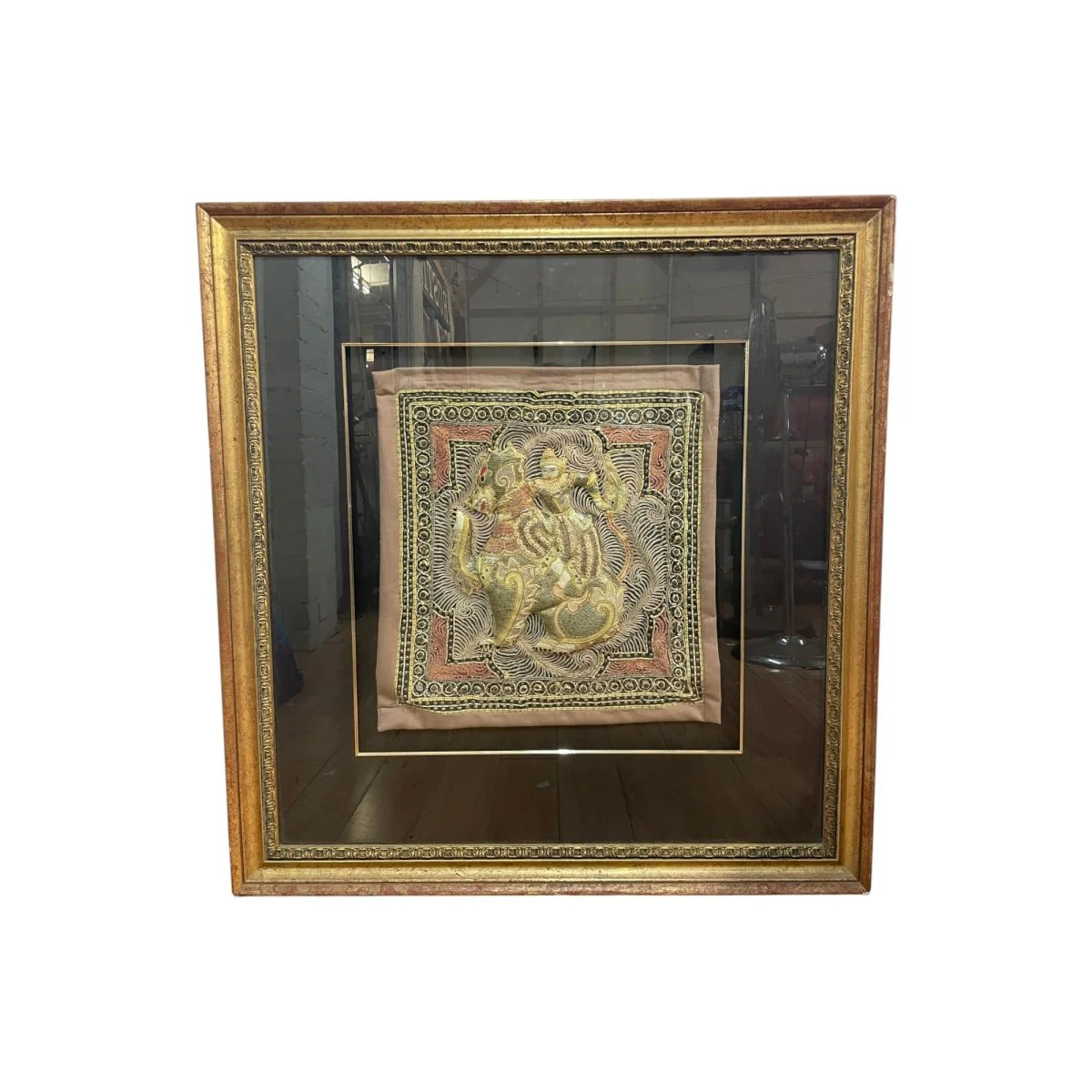
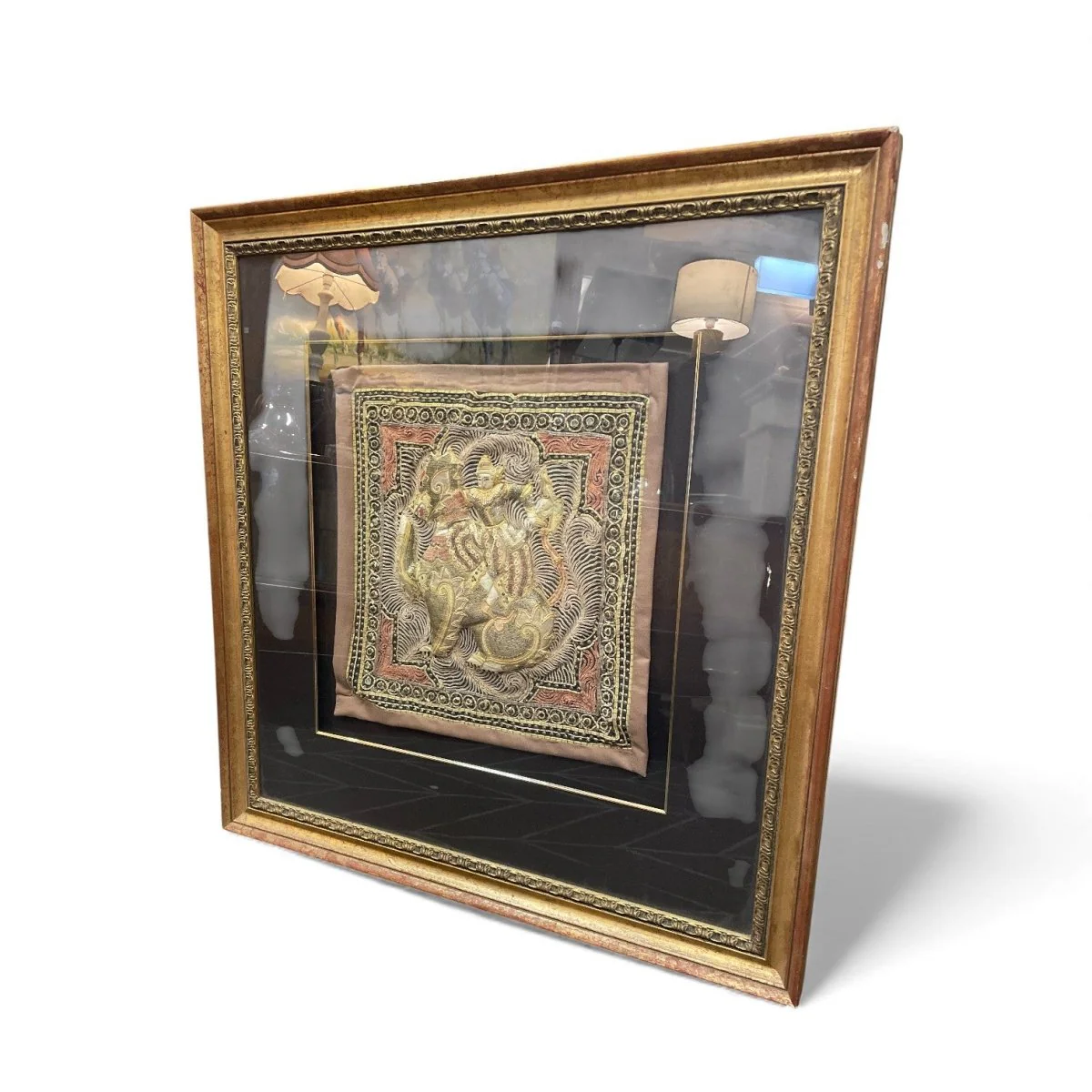
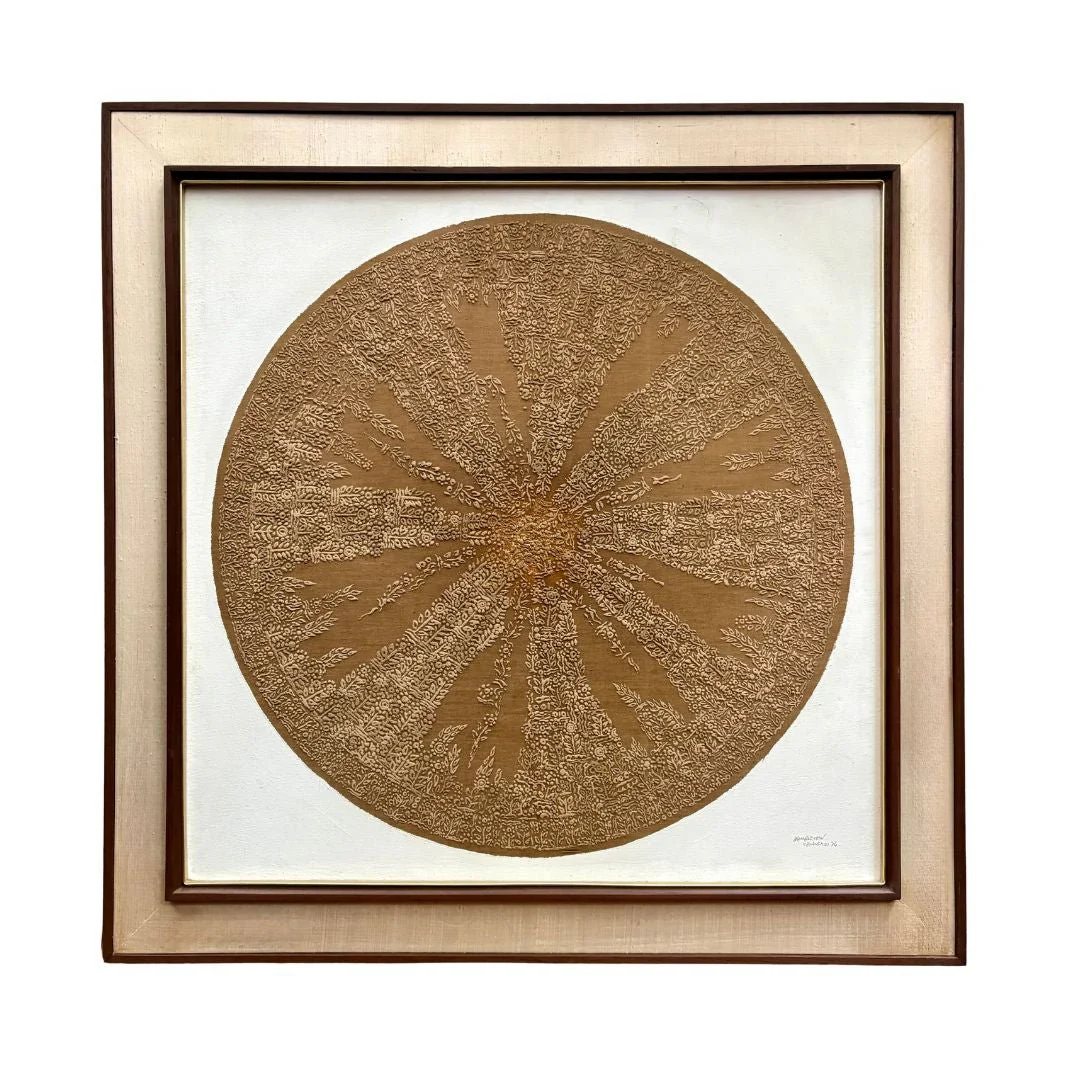
Sculpted sand, pigment and gold gilt on canvas with painted surround. Signed lower right: Wancharoen Chiangmai ’76
60 x 60 cm (within mount) 74 x 74 cm framed. Fine quality teak frame with silk mount.
A powerful and contemplative circular mandala composition created in Chiang Mai in 1976, this work exemplifies Wancharoen Japakang’s deeply textural and spiritually inflected abstraction of the 1970s.
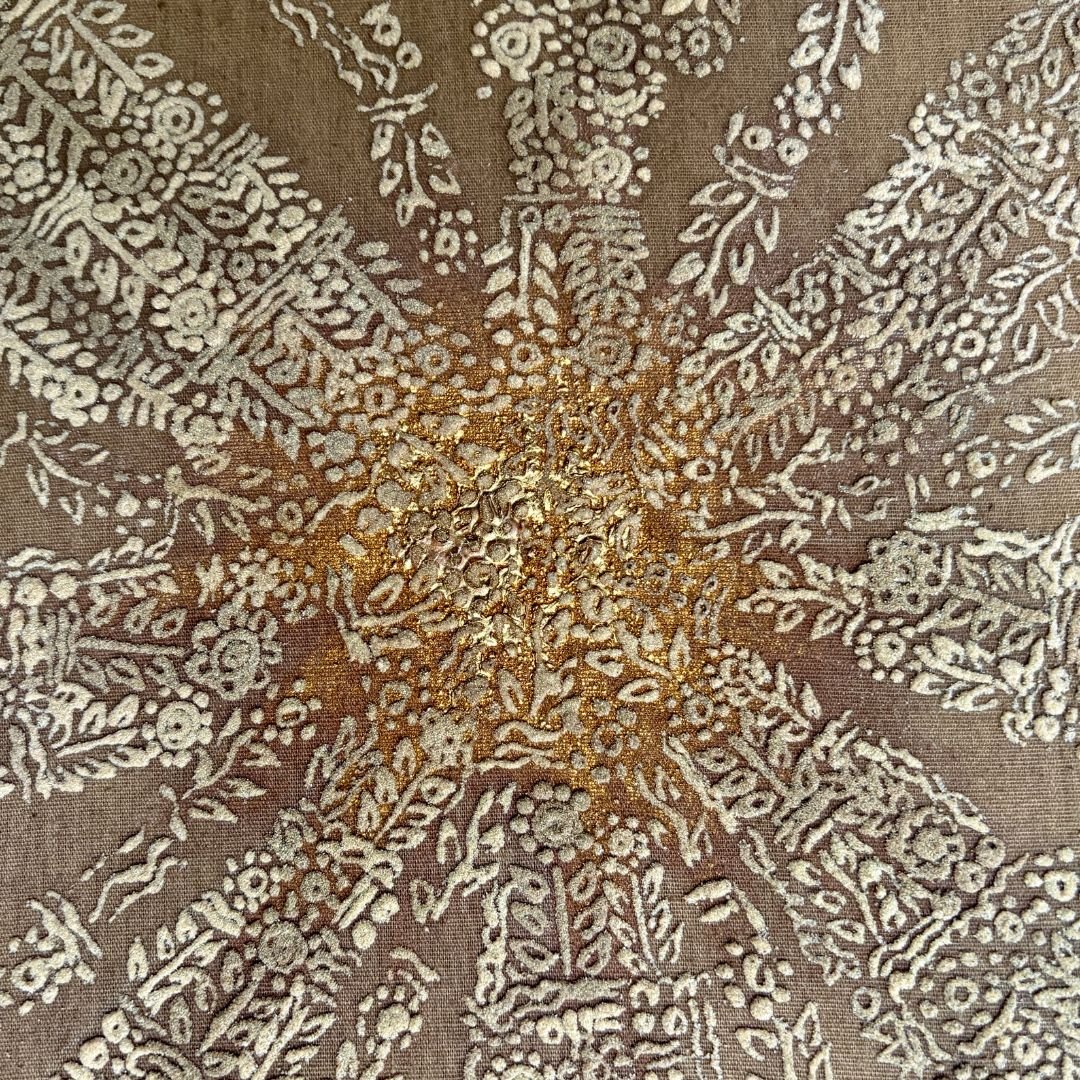
The central disc is built up from intricately sculpted sand and earth-based pigment applied over canvas, forming a dense relief surface of rhythmic motifs. These radiating segments emanate from a luminous gold-gilt centre, creating a cosmological axis, a Buddhist inspired visual meditation on spiritual energy, expansion and transcendence.
The surface is richly tactile: thousands of hand-worked impressions form a repeating mandala forming pattern suggestive of sacred motifes, temple ornament, and ritual diagram. The painted canvas surround frames the mandala within a contemplative field, enhancing the object’s presence as both painting and relief sculpture.
The work retains its original fine teak frame with silk mount, sympathetic to its period and Southeast Asian context.
Buddhist & Symbolic Context
Mandala structures in Thai modernism frequently draw upon Buddhist cosmology, specifically the idea of Mount Meru as the spiritual axis of the universe. The radiating geometry and gilded centre echo temple ceiling designs and sacred diagrams used in meditation practices.
Here, Japakang transforms traditional cosmological symbolism into modern abstraction. The gold centre suggests enlightenment or awakened consciousness, while the outward movement of relief forms reflects the cyclical nature of existence and spiritual diffusion.
This is not decorative abstraction; it is meditative and cosmological in intent.
Artist Biography
Wancharoen Japakang is a significant Thai modernist whose work bridges traditional Southeast Asian visual language and international abstraction. Emerging in the 1960s and 1970s, he belongs to the generation of artists who expanded Thai art beyond academic realism into textured, symbolic modernism.
Working extensively in Chiang Mai, he developed a distinctive relief technique using sand, pigment and incised surface patterning. His works are held in important Thai institutional collections including:
* National Gallery of Thailand (Bangkok)
* Silpakorn University collections
* Chiang Mai University Art Collection
* Various regional museum holdings in Southeast Asia
Japakang is recognised within the broader Southeast Asian modernist diaspora as a key figure in the evolution of spiritually grounded abstraction. While less widely known in Western markets, his importance within Thai art history is well established.
Works from the mid-1970s, particularly circular mandala compositions of this scale and condition are comparatively scarce and represent his mature period.
Condition
Very good vintage condition. Minor age-appropriate surface wear consistent with period materials. Frame and silk mount present beautifully.
Why This Work Matters
* Strong 1970s Southeast Asian modernism
* Authentic Chiang Mai period work
* Sculptural relief surface with gold gilt
* Powerful interior presence at ideal collector scale
* Institutional artist with established auction history
Original: $2,094.31
-70%$2,094.31
$628.29Product Information
Product Information
Shipping & Returns
Shipping & Returns
Description
Description
Sculpted sand, pigment and gold gilt on canvas with painted surround. Signed lower right: Wancharoen Chiangmai ’76
60 x 60 cm (within mount) 74 x 74 cm framed. Fine quality teak frame with silk mount.
A powerful and contemplative circular mandala composition created in Chiang Mai in 1976, this work exemplifies Wancharoen Japakang’s deeply textural and spiritually inflected abstraction of the 1970s.
The central disc is built up from intricately sculpted sand and earth-based pigment applied over canvas, forming a dense relief surface of rhythmic motifs. These radiating segments emanate from a luminous gold-gilt centre, creating a cosmological axis, a Buddhist inspired visual meditation on spiritual energy, expansion and transcendence.
The surface is richly tactile: thousands of hand-worked impressions form a repeating mandala forming pattern suggestive of sacred motifes, temple ornament, and ritual diagram. The painted canvas surround frames the mandala within a contemplative field, enhancing the object’s presence as both painting and relief sculpture.
The work retains its original fine teak frame with silk mount, sympathetic to its period and Southeast Asian context.
Buddhist & Symbolic Context
Mandala structures in Thai modernism frequently draw upon Buddhist cosmology, specifically the idea of Mount Meru as the spiritual axis of the universe. The radiating geometry and gilded centre echo temple ceiling designs and sacred diagrams used in meditation practices.
Here, Japakang transforms traditional cosmological symbolism into modern abstraction. The gold centre suggests enlightenment or awakened consciousness, while the outward movement of relief forms reflects the cyclical nature of existence and spiritual diffusion.
This is not decorative abstraction; it is meditative and cosmological in intent.
Artist Biography
Wancharoen Japakang is a significant Thai modernist whose work bridges traditional Southeast Asian visual language and international abstraction. Emerging in the 1960s and 1970s, he belongs to the generation of artists who expanded Thai art beyond academic realism into textured, symbolic modernism.
Working extensively in Chiang Mai, he developed a distinctive relief technique using sand, pigment and incised surface patterning. His works are held in important Thai institutional collections including:
* National Gallery of Thailand (Bangkok)
* Silpakorn University collections
* Chiang Mai University Art Collection
* Various regional museum holdings in Southeast Asia
Japakang is recognised within the broader Southeast Asian modernist diaspora as a key figure in the evolution of spiritually grounded abstraction. While less widely known in Western markets, his importance within Thai art history is well established.
Works from the mid-1970s, particularly circular mandala compositions of this scale and condition are comparatively scarce and represent his mature period.
Condition
Very good vintage condition. Minor age-appropriate surface wear consistent with period materials. Frame and silk mount present beautifully.
Why This Work Matters
* Strong 1970s Southeast Asian modernism
* Authentic Chiang Mai period work
* Sculptural relief surface with gold gilt
* Powerful interior presence at ideal collector scale
* Institutional artist with established auction history