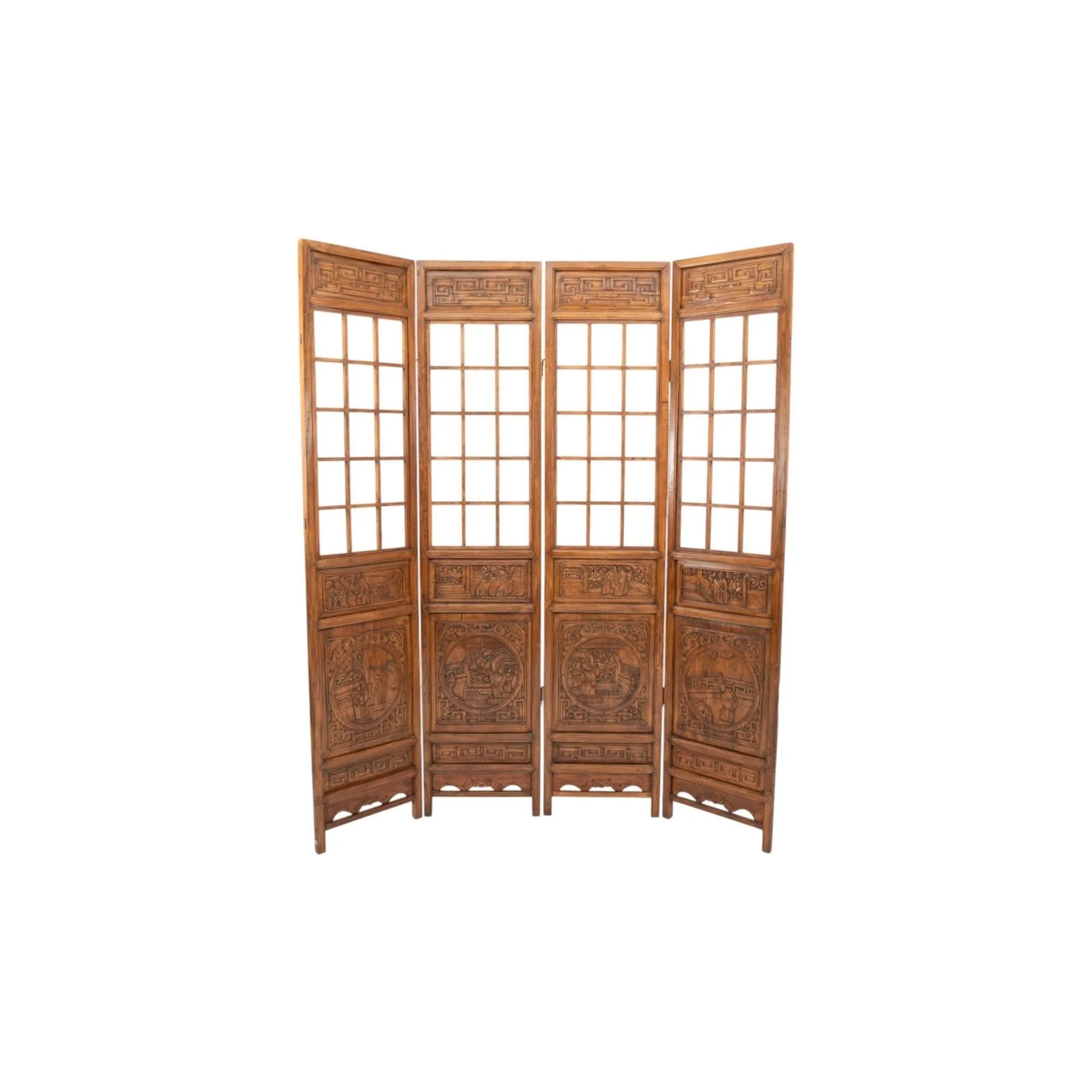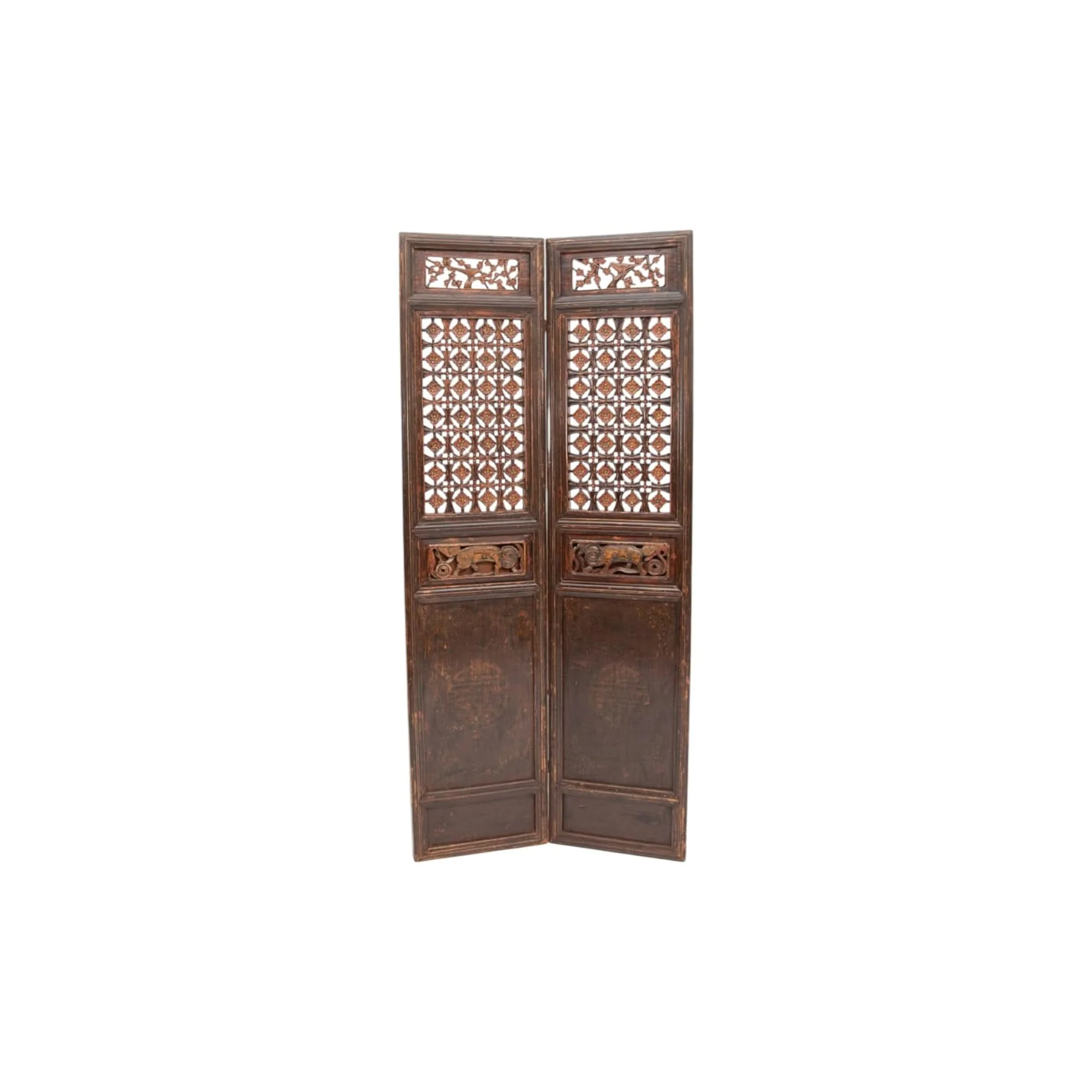

Two panel screen with open carved medallions
19th century
- elm
- 217cm H x 50cm W x 7cm D (each panel)
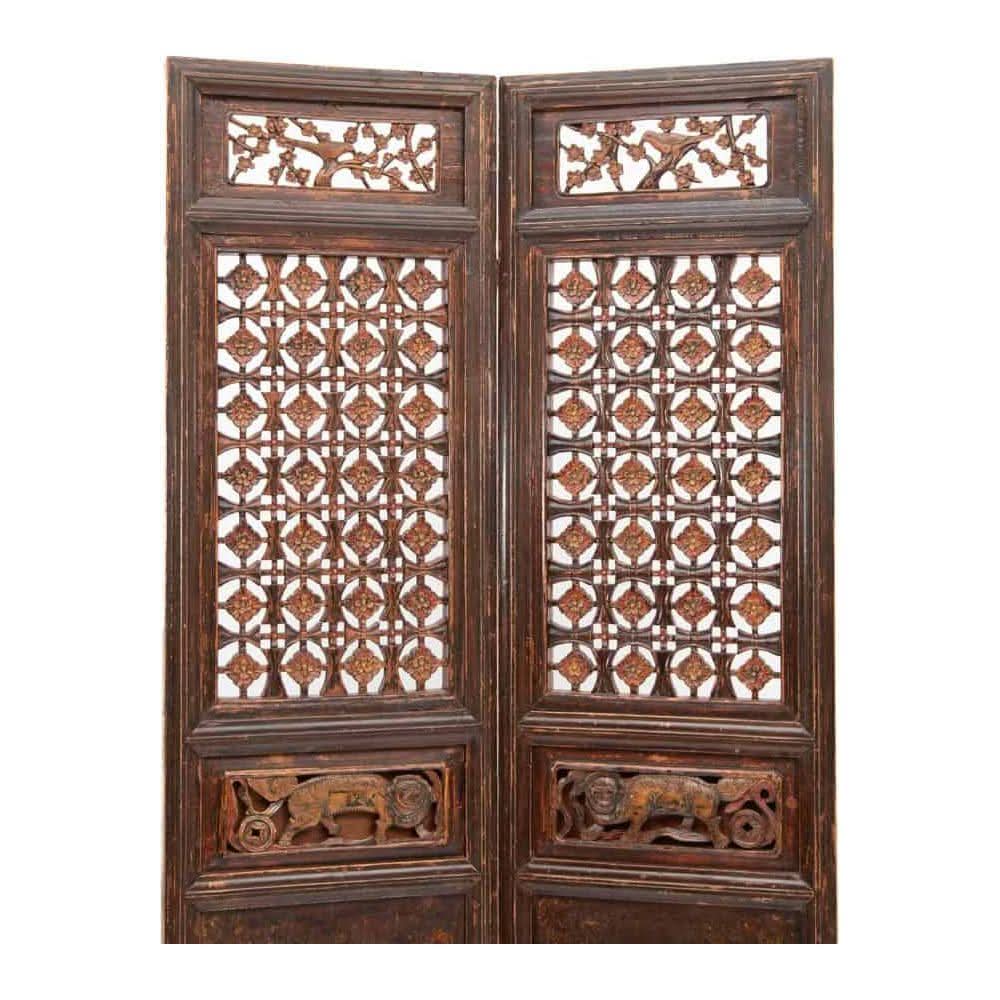
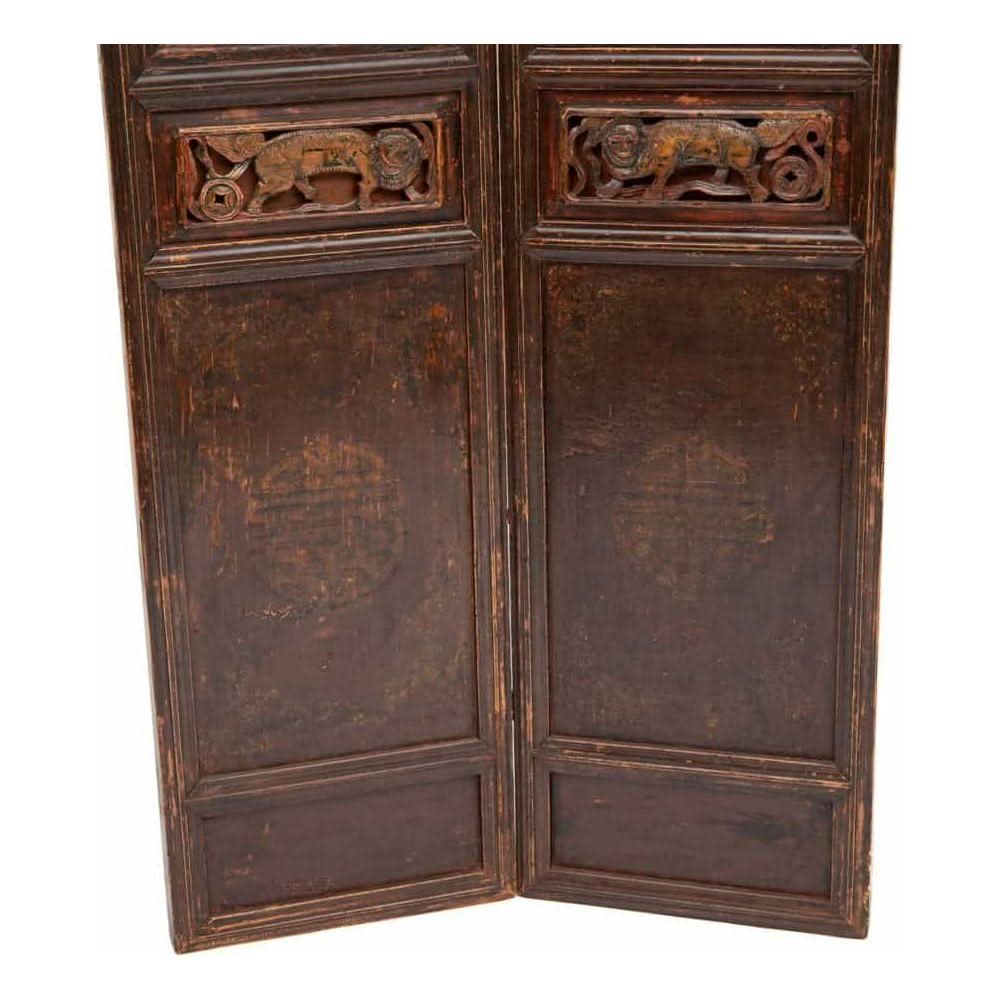
Fascinating screen with combination of relief and open carving with painted elements as well.
Screens first appeared in the Warring States period (475B.C.E. - 221B.C.E.) and since that time have been one of the most architectural pieces of Chinese furniture. In the early periods of history they were used as partitions when houses had few internal walls. They were later used to establish different styles within a single room; they can be placed around the corner of a room to soften angles and instil a sense of artistic sensitivity; or stand along a wall to add grandeur and height.
Screens offer both privacy and protection. Screens can be placed across an entrance to prevent people seeing into the room behind. They were also a place for a person to sit behind and listen in on discussions. In Chinese, screens are called “pingfeng” which means to shield against the wind. According to traditional Chinese medical theory, wind, along with other environmental factors such as heat, cold and damp, can lead to disease. Excessive exposure should be avoided and screens were used to protect people against cold draughts.
The individual designs had infinite variations, ranging from the simple to the intricate and ornate. Relief and openwork carving was employed to display auspicious symbols, religious concepts and scenes from famous stories. The lattice sections were often covered with silk or rice paper and painted.
The upper panel has carving of magpies among plum blossoms. The magpie and plum blossom forms an idiomatic expression. Literally it means the magpie (xi que) is on the top of the plum blossom (mei shao). Another meaning using different characters but the same pronunciation is may your happiness (xi) reach (shang) the top of your eyebrows (mei shao). Magpie and plum blossom is therefore a wish for great happiness.
The central panel has plum blossoms, each petal represents one of the Five Blessings of Happiness, Good Health, Long Life, Love of Virtue and Peaceful Passing. The lions signify scholastic pursuit while the lower panel has long life medallion painting.
Original: $2,164.12
-70%$2,164.12
$649.24Product Information
Product Information
Shipping & Returns
Shipping & Returns
Description
19th century
- elm
- 217cm H x 50cm W x 7cm D (each panel)
Fascinating screen with combination of relief and open carving with painted elements as well.
Screens first appeared in the Warring States period (475B.C.E. - 221B.C.E.) and since that time have been one of the most architectural pieces of Chinese furniture. In the early periods of history they were used as partitions when houses had few internal walls. They were later used to establish different styles within a single room; they can be placed around the corner of a room to soften angles and instil a sense of artistic sensitivity; or stand along a wall to add grandeur and height.
Screens offer both privacy and protection. Screens can be placed across an entrance to prevent people seeing into the room behind. They were also a place for a person to sit behind and listen in on discussions. In Chinese, screens are called “pingfeng” which means to shield against the wind. According to traditional Chinese medical theory, wind, along with other environmental factors such as heat, cold and damp, can lead to disease. Excessive exposure should be avoided and screens were used to protect people against cold draughts.
The individual designs had infinite variations, ranging from the simple to the intricate and ornate. Relief and openwork carving was employed to display auspicious symbols, religious concepts and scenes from famous stories. The lattice sections were often covered with silk or rice paper and painted.
The upper panel has carving of magpies among plum blossoms. The magpie and plum blossom forms an idiomatic expression. Literally it means the magpie (xi que) is on the top of the plum blossom (mei shao). Another meaning using different characters but the same pronunciation is may your happiness (xi) reach (shang) the top of your eyebrows (mei shao). Magpie and plum blossom is therefore a wish for great happiness.
The central panel has plum blossoms, each petal represents one of the Five Blessings of Happiness, Good Health, Long Life, Love of Virtue and Peaceful Passing. The lions signify scholastic pursuit while the lower panel has long life medallion painting.